Seeing Ski
About this project
A mini ski-like attachment that can attach to the bottom of a seeing cane.
The challenge
While tools for the seeing impaired do exist, in their day-to-day usages, they are difficult to completely integrate into a life without feeling cumbersome. Another problem with seeing canes is that the tip is often caught onto cracks or bumps, causing the user to fall. As Gloria, our "need-knower" explained, many people develop knee problems due to falling too much. Many 'smartcanes' have an audio response, which can consists of beeping or of a speaking voice. This method is very public, which could be embarrassing, or ineffective in noisy environments. Moreover, many users find the traditional "smartcanes" expensive and difficult to learn, and therefore not worthwhile.
Who it helps
Gloria is legally blind.
How it works
The team on Gloria's Project, inspired by Gloria herself, worked on the first model of "The Excalibur".
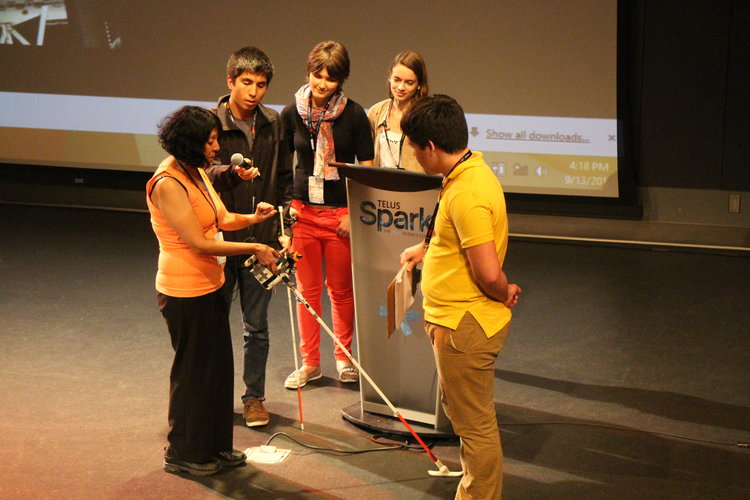
In conjunction with the first issue, they created a mini ski-like attachment that can attach to the bottom of a seeing cane. The design of the 'seeing-ski' allowes movement along the y-axis, it allows flexibility of movement and it can be flipped up when not in use (such as being indoors). The first prototype was 3D printed and fitted onto a standard seeing cane from the Canadian National Institute for the Blind. This would prevent the tip of the cane from catching onto obstacles, cracks, or holes and diminish the likelihood of tripping the user - while still allowing them to feel the texture of the ground around them.
To address the second issue, "The Excalibur" will have a versatile handle suitable for both the standard “Seeing Cane” and the “ID Cane” (the first is meant as a tool for those who are completely blind and the latter for those who are partially blind). The handle is designed so that two sensors (one is sonar and the other is light) will detect obstacles in front of and above the user respectively. These sensors are placed in mechanical swivel heads to hold and adjust the placement of the sensors. Two output sensors nested comfortably in the hand of the user provide personal tactile feedback. Finally, housed within the frame of the 3D printed handle sits a rechargeable battery and processor. While we didn't originally plan for attachments to the existing seeing cane, we eventually agreed that it would be the most advantageous approach. Some of the issues arriving to our conclusions included where to focus the weight of our attachment. It was originally meant to communicate with a bluetooth bracelet, similar to a smartwatch in terms of privacy and signalling, but relying on feedback from sensors on the cane. After closer observation with Gloria (and using canes ourselves) we realized that it would be more advantageous and simpler to keep the sensors on the handle attachment, close at 'hand'. Thus, came the electronic 'hilt' of our Excalibur. In doing so, we would have a simpler, easy way to use the model while also being able to keep our cost down.
Working with Gloria and keeping individuals with visual impairment at the design table, we aimed to develop an insightful, personal, and intuitive tool to overcome what shouldn't have been a challenge in the first place, and we believe that our prototype is the right first step through enhancing both privacy and utility. We hope to continue with our project, amending the material used as well as improving the sophistication of our current obstacle detection system. With a working prototype, this gives us a clearer picture of what we want our product to be able to do. And from what Gloria has told us, it's a direction well worth taking.
Project details
- Stage: Prototype
- Built by the Alberta community, Calgary, Canada
- Team: Gloria
- Category: Daily Living
- 53 downloads
The build files for Seeing Ski are free to download from this page - open source, shared by TOM: Tikkun Olam Makers.
Related projects
- Straight up G
- Cupability
- Text2Speech
- SmartVision Stick
- Thenar - Electronic brail reader
- Toddler Food Cart
Browse all TOM projects · Search projects · TOM communities · Makeathons and events