Yes/No CVI Device
About this project
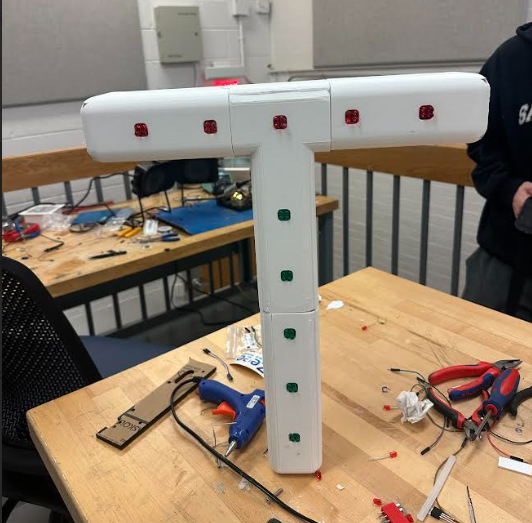
Cortical Visual Impairment (CVI) often accompanies Cerebral Palsy - a visual impairment caused by the brain, not unhealthy eyes. This device was requested by a therapist at HMS for her therapy sessions and has already requested another. The device consists of 2 lines of LED lights (red and green) that bounce along a path at controlled speed. We are refining the solution through their feedback.
The challenge
This project will help those who struggle with communication to effectively communicate a yes or no, promoting accessibility and independence.
Who it helps
Children learning communication, nonverbal users, people in rehabilitation programs
How it works
This project will help those who struggle with communication to effectively communicate a yes or no, promoting accessibility and independence, as well as training thier eye muscles to move along these paths.
Following the LED clusters will allow users to mimic a shaking and nodding head to effectively communicate yes or no.
An LED device with clusters of LEDs in one line going vertically and another going horizontally, pointing out a shaking direction (left and right) and nodding direction (up and down).
Tools/Parts Needed:
PC or MAC 17+ - hardware
Prusa Slicer (or printer slicer of choice) - software
FDM Printer - hardware
5 mm LEDs
Wires
Arduino Uno
Slide Potentiometer
Rocker Switches
Soldering set
Project details
- Stage: Prototype
- Built by the University of Pennsylvania community, Philadelphia, Pennsylvania, United States of America
- Team: HMS School
- Category: Daily Living, Therapy
- 1 downloads
The build files for Yes/No CVI Device are free to download from this page - open source, shared by TOM: Tikkun Olam Makers.
Related projects
- Chairlift
- Button (Large Adaptive Switch)
- SHIRA RhythmSteps
- Wonder Rope
- Blade Lock
- Affordable hinged Ankle-Foot Orthosis
Browse all TOM projects · Search projects · TOM communities · Makeathons and events